
Anúncios
Have you ever wondered how a simple block-fitting challenge managed to captivate millions of people around the globe for decades? The answer lies in a brilliant creation born within the corridors of the Soviet Union—one that transformed digital entertainment forever.
Created by Alexey Pajitnov in 1984, the project began as a modest idea that quickly transcended political and cultural boundaries.
Anúncios
Today, we explore the details of this incredible journey. Get ready to discover how pure mathematical logic evolved into a massive cultural phenomenon, retaining its relevance to this day.
Alexey Pajitnov’s journey in the Soviet Union
Tetris®
You will be redirected to another website.
Tetris®
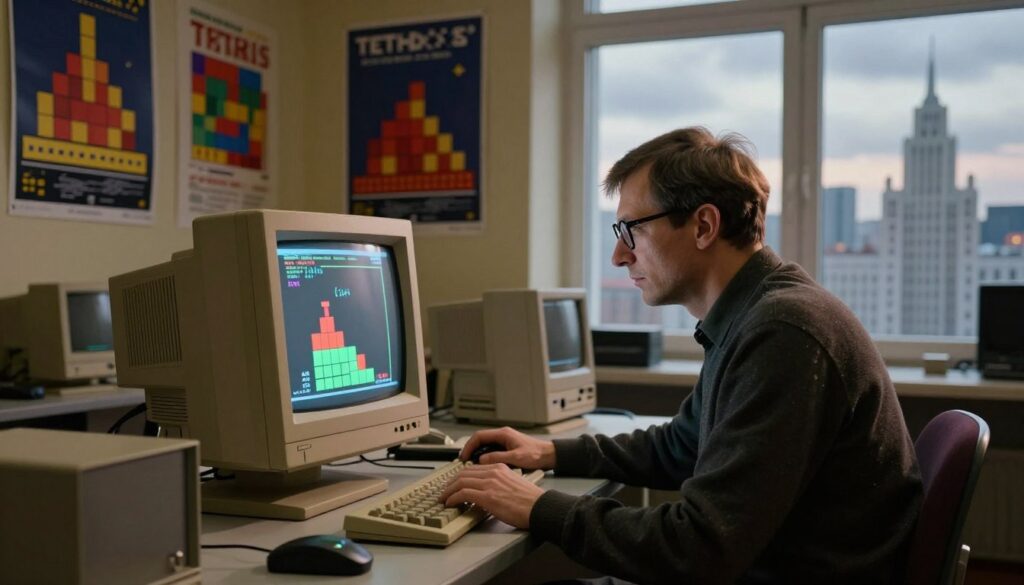
Within the halls of the USSR Academy of Sciences, a simple idea revolutionized digital entertainment. It was in this academic setting—far removed from major commercial studios—that Alexey Pajitnov began developing what would become a global phenomenon.
Anúncios
The developer drew inspiration from traditional puzzles, such as pentominoes, to create something new. He sought to combine logic and fun in a format that could run on the computers of the time, which had extremely limited technical capabilities.
Programming the project required immense creativity, as the available hardware could not support complex graphics or advanced sound effects.
Alexey Pajitnov had to optimize every line of code to ensure a smooth, addictive experience while overcoming the technological limitations of the era.
This technical dedication laid the groundwork for the history of video games as we know them today. The final result proved that pure gameplay is the most crucial element for any title’s success.
Global expansion and the battle for rights

Few video games have faced as turbulent a journey as Tetris in its quest for licensing.
After its inception, the title became the center of a complex dispute involving major names in digital entertainment—a pivotal phase in defining how intellectual property rights would be handled in the international market.
The game’s global expansion was neither simple nor planned. On the contrary, it was marked by intense negotiations that shaped the evolution of gaming throughout the 1980s.
Various companies vied for exclusive distribution rights, turning the original code into a valuable asset for the industry.
These legal conflicts ultimately accelerated the title’s popularization across multiple platforms. What began as an academic project in the Soviet Union quickly transformed into a global phenomenon that crossed the Iron Curtain, proving that digital entertainment knew no geographic or political boundaries.
Understanding this battle is essential to analyzing the evolution of modern gaming. The success of Tetris set new industry standards, demonstrating that simplicity could conquer the world.
Today, we view these events as a milestone in video game history, cementing the title’s status as a true global phenomenon that has stood the test of time.
The game’s history and its impact on pop culture
Few video games have shaped pop culture as profoundly as Tetris. Since its inception, the title has evolved from a mere pastime into a visual symbol recognized across the globe.
The gaming community embraced the game as an icon of challenge and persistence. Players of all ages see the falling blocks as a perfect metaphor for problem-solving and unwavering focus.
The brand’s reach is vast and evident across various sectors of society. Tetris has influenced content creators, artists, and designers over the past few decades.
We can highlight a few areas where the game’s impact has become evident:
- Fashion: block patterns on iconic clothing and accessories.
- Music: references in music videos and electronic compositions.
- Cinema: appearances in films aiming to capture the nostalgia of the 80s.
- Design: inspiration for minimalist furniture and décor.
- Digital art: exhibitions celebrating the game’s geometric aesthetic.
Why Tetris Became a Timeless Classic
The magic of Tetris lies in a formula that transcends time and platforms. Even after decades of technological advancements, classic Tetris remains a benchmark in the world of digital gaming.
The secret behind this success is its addictive gameplay, which challenges players to constantly improve. This simple yet profound mechanic ensures the title never feels outdated, regardless of the device used.
The legacy of Tetris is built on a rewarding experience that appeals to both casual players and professional competitors. As players arrange blocks at a frenetic pace, they enter a state of mental focus that few other games can provide.
Clear psychological elements explain this enduring appeal. The human need to organize patterns and the immediate satisfaction of completing a line create a powerful reward cycle.
That is why the addictive gameplay of classic Tetris remains relevant today. The game has not only survived the industry’s evolution but continues to win over new fans around the globe every day.
Simple mechanics that challenge the brain
Tetris’s game mechanics are a perfect example of mind-challenging minimalist design. Everything revolves around the precise manipulation of geometric blocks descending the screen at increasing speeds.
This clever puzzle game requires players to make quick decisions under constant pressure. Every move creates a mental challenge that keeps focus and attention heightened throughout the match.
The beauty of the system lies in how easy it is to grasp, allowing anyone to start playing within seconds. Yet, the strategic depth required to achieve high scores is what makes the experience so rewarding.
It is this combination of basic rules and addictive gameplay that has ensured the title’s success for decades. Players feel immediate satisfaction when completing lines, stimulating the brain to constantly strive for better performance.
Technical analysis of modern versions
The evolution of gaming has transformed this classic puzzle game into a sophisticated digital experience.
Current editions utilize advanced technologies to refine gameplay, ensuring the essence of the challenge remains intact while visual performance reaches new heights.
The game mechanics have been carefully optimized to offer a more fluid response to player inputs. With high-definition graphics and stable frame rates, every movement of the pieces is more precise and satisfying than in versions from decades past.
Furthermore, the integration of online modes has significantly expanded the reach of modern Tetris, allowing the original design’s solid foundation to support global competitions and social interaction—proving that a well-structured concept can adapt perfectly to the technological demands of today’s market.
The enduring legacy of minimalist design
Tetris’s minimalist design transformed simple blocks into an enduring cultural icon. Functionality guides the aesthetic so precisely that the game remains intuitive even after decades of technological evolution.
Visual clarity is the central pillar supporting the success of this masterpiece. By focusing on the essence of gameplay, the game’s creator ensured the experience was accessible to everyone, regardless of age or familiarity with technology.
The legacy of Tetris is clear proof that simplicity stands the test of time with elegance. While many modern games aim for complex graphics, this classic proves that pure fun requires no visual excess.
There are fundamental reasons why these geometric blocks continue to captivate new players every day:
- The absence of visual distractions allows for total focus on the strategy.
- The iconic shape of the pieces facilitates immediate recognition.
- The limited color palette aids mental organization during the game.
- The basic geometric structure makes learning quick and natural.
Conclusion

The trajectory of this game proves that simple creativity shapes the future of digital entertainment. Alexey Pajitnov created something that transcends generations and platforms.
Modern Tetris demonstrates how basic mechanics adapt to new technologies. Current versions retain the original essence while attracting new audiences around the world.
This title remains a cornerstone of gaming culture, uniting players of all ages in a constant challenge of logic and reflexes.